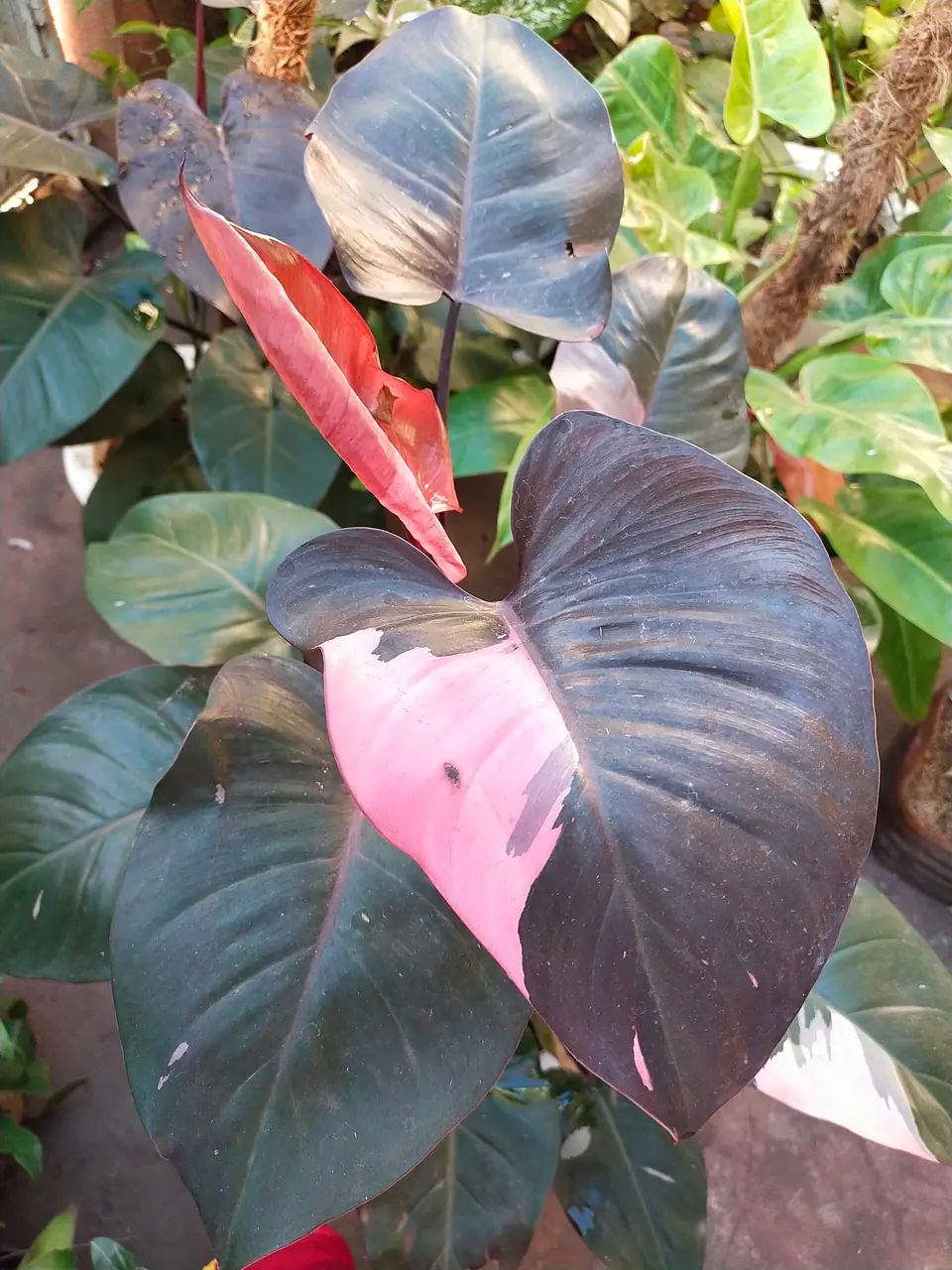
How to care for Pink Princess Philodendron
Philodendron erubescens 'Pink Princess' · Araceae
A climbing philodendron prized for dark, almost black-green leaves splashed with bubblegum pink variegation. Because the pink tissue holds no chlorophyll, the plant walks a line: too little light and the pink fades, while all-pink leaves cannot feed themselves and eventually brown. Thoughtful pruning back to well-balanced leaves keeps the variegation stable. Water roughly every 7 days while it's growing (about every 12 in winter), give it bright, indirect light, kept above 59°F (15°C) — average room humidity suits it.
Care at a glance
Water when the top third of the pot dries; pink sections brown quickly under drought or waterlogging alike.
Bright indirect light is essential for pink colour — a spot near an east window or filtered south exposure is ideal.
Half-strength balanced fertilizer monthly; overfeeding burns the variegated tissue first.
Mistakes that kill this plant
- Overwatering a plant kept in insufficient light.
- Chasing all-pink leaves — they cannot photosynthesize and drag the plant down.
- Letting thrips ruin every new leaf on a slow-growing, costly plant.
Seasonal tips
- Prune back to a well-variegated node in spring if leaves revert to plain green.
- Give it the brightest indirect spot you have during dark winters, or supplement with a grow light.
- Stake or pole it in spring — climbing encourages larger, better-marked leaves.
Is it safe for pets?
We have Pink Princess Philodendron recorded as toxic to cats and dogs.
Full pet-safety details for cats & dogsCare for your Pink Princess Philodendron on autopilot
Ploomily turns this guide into a Living Schedule — watering tuned to your city’s climate, the season, the pot and the light, and feeding tuned to that same pot, drainage and light, following the growing season and pausing while the plant rests. The founding price in force today is shown in full before you confirm, and locked for as long as you stay subscribed — with 30 days to change your mind.
Build my Living ScheduleMore foliage plants
Toxicity here is informational, not a safety guarantee. Those are our own records, compiled by following the ASPCA's published toxic and non-toxic plant lists and Pet Poison Helpline's plant poison list rather than copied from them — confirm anything that matters against the ASPCA's published lists, which this one is matched to, or with your vet. If your pet ingested this plant, contact your vet or the ASPCA Animal Poison Control Center at (888) 426-4435.