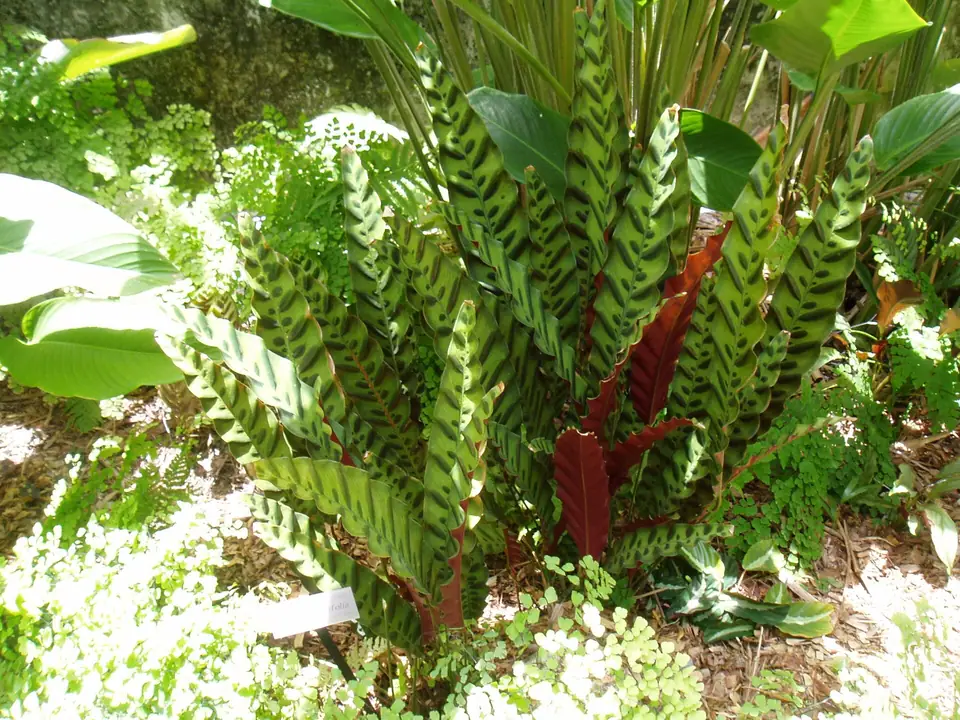
How to care for Rattlesnake Plant
Goeppertia insignis · Marantaceae
Long, wavy-edged leaves patterned with dark green blotches over lime, with striking purple undersides. Among the calatheas it is one of the more tolerant, forgiving small slips in humidity better than its cousins. Still, it wants steady moisture and soft water. Water roughly every 5 days while it's growing (about every 9 in winter), give it a bright room away from the window, kept above 59°F (15°C) — it wants humid air.
Care at a glance
Water when the surface just begins to dry, keeping the mix evenly moist with filtered or rainwater.
Medium to bright indirect light; direct sun washes out the pattern and crisps the wavy edges.
Dilute balanced fertilizer at quarter strength monthly in spring and summer.
Mistakes that kill this plant
- Letting it dry out repeatedly — each drought costs leaves it is slow to replace.
- Watering with softened or very hard tap water long term.
- Parking it over a heat vent where air is hot and bone dry.
Seasonal tips
- Curling leaves in winter usually mean dry air or dry soil, not disease.
- Ease off fertilizer entirely from autumn to spring.
- Refresh the top layer of mix in spring to flush accumulated salts.
Is it safe for pets?
Our records list Rattlesnake Plant as non-toxic to cats and dogs.
Full pet-safety details for cats & dogsCare for your Rattlesnake Plant on autopilot
Ploomily turns this guide into a Living Schedule — watering tuned to your city’s climate, the season, the pot and the light, and feeding tuned to that same pot, drainage and light, following the growing season and pausing while the plant rests. The founding price in force today is shown in full before you confirm, and locked for as long as you stay subscribed — with 30 days to change your mind.
Build my Living ScheduleRattlesnake Plant is featured in
More foliage plants
Toxicity here is informational, not a safety guarantee. Those are our own records, compiled by following the ASPCA's published toxic and non-toxic plant lists and Pet Poison Helpline's plant poison list rather than copied from them — confirm anything that matters against the ASPCA's published lists, which this one is matched to, or with your vet. If your pet ingested this plant, contact your vet or the ASPCA Animal Poison Control Center at (888) 426-4435.