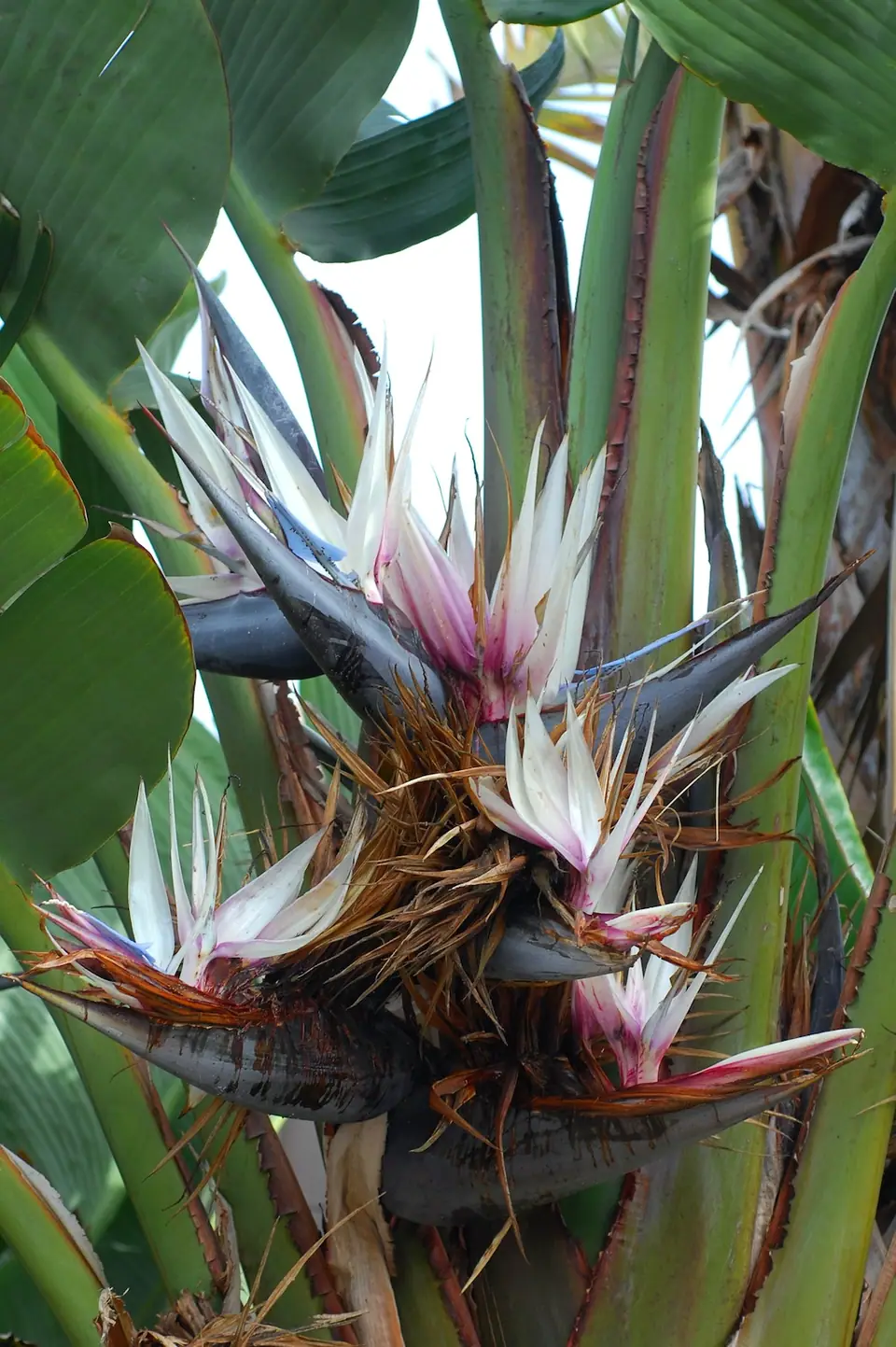
How to care for White Bird of Paradise
Strelitzia nicolai · Strelitziaceae
A statement plant with huge banana-like paddle leaves fanning from upright stems, capable of reaching the ceiling indoors. It rarely flowers inside, but the architectural foliage alone earns its place. Give it real sun and room to grow, and expect some natural leaf splitting — that's normal, not a problem. Water roughly every 7 days while it's growing (about every 14 in winter), give it direct sun, kept above 54°F (12°C) — average room humidity suits it.
Care at a glance
Water deeply when the top third of the pot is dry; the thick roots store moisture and resent constant wetness.
Give it your sunniest window; several hours of direct sun keep growth sturdy and upright.
Balanced liquid fertilizer at half strength every few weeks in spring and summer.
Mistakes that kill this plant
- Trying to grow it in a dim corner, where it slowly declines over months.
- Keeping a huge pot constantly wet until the roots rot.
- Cold drafts and chilled window glass against the leaves in winter.
Seasonal tips
- Rotate the pot regularly so the leaf fan grows evenly toward the light.
- Wipe or shower the big leaves monthly to remove dust.
- Slow watering right down in winter when growth pauses.
Is it safe for pets?
We have White Bird of Paradise recorded as toxic to cats and dogs.
Full pet-safety details for cats & dogsCare for your White Bird of Paradise on autopilot
Ploomily turns this guide into a Living Schedule — watering tuned to your city’s climate, the season, the pot and the light, and feeding tuned to that same pot, drainage and light, following the growing season and pausing while the plant rests. The founding price in force today is shown in full before you confirm, and locked for as long as you stay subscribed — with 30 days to change your mind.
Build my Living ScheduleMore foliage plants
Toxicity here is informational, not a safety guarantee. Those are our own records, compiled by following the ASPCA's published toxic and non-toxic plant lists and Pet Poison Helpline's plant poison list rather than copied from them — confirm anything that matters against those lists or with your vet. If your pet ingested this plant, contact your vet or the ASPCA Animal Poison Control Center at (888) 426-4435.