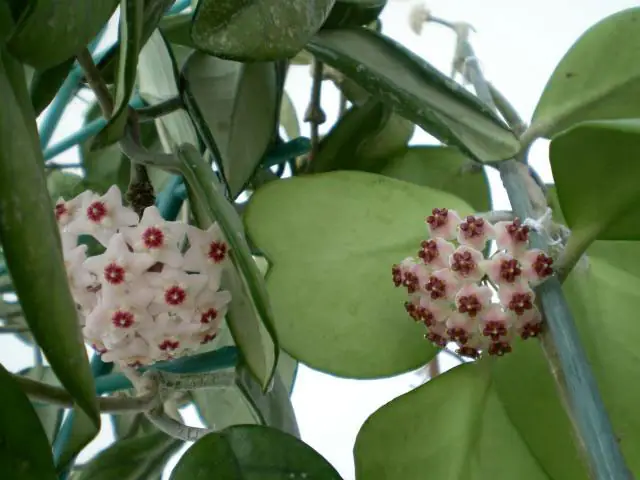
How to care for Sweetheart Hoya
Hoya kerrii · Apocynaceae
Famous for its thick, heart-shaped leaves, often sold as a single rooted leaf around Valentine's Day. Note that a single leaf without a stem node will stay a lone heart forever — only vining plants with stems will actually grow. Mature plants are robust, drought-tolerant climbers with chunky foliage and classic hoya flower umbels. Water roughly every 12 days while it's growing (about every 24 in winter), give it bright, indirect light, kept above 54°F (12°C) — average room humidity suits it.
Care at a glance
The very thick leaves store lots of water — let the mix dry out almost completely, then soak; softening leaves mean it is thirsty.
Give it very bright indirect light with some direct morning sun; it tolerates more sun than thinner-leaved hoyas.
Half-strength balanced fertilizer every 4-6 weeks during active growth.
Mistakes that kill this plant
- Watering it like a tropical — this is functionally a succulent and drowns easily.
- Buying a single potted leaf and expecting a plant; without a node it never vines.
- Keeping it in a cold, damp window in winter, which invites stem rot.
Seasonal tips
- Expect very slow growth — a vining kerrii may put out only a few leaves a year.
- Reduce watering to monthly in winter and hold fertilizer until spring.
- New growth often starts as a bare vine before leaves appear; do not trim it off.
Is it safe for pets?
Our records list Sweetheart Hoya as non-toxic to cats and dogs.
Full pet-safety details for cats & dogsCare for your Sweetheart Hoya on autopilot
Ploomily turns this guide into a Living Schedule — watering tuned to your city’s climate, the season, the pot and the light, and feeding tuned to that same pot, drainage and light, following the growing season and pausing while the plant rests. The founding price in force today is shown in full before you confirm, and locked for as long as you stay subscribed — with 30 days to change your mind.
Build my Living ScheduleSweetheart Hoya is featured in
More vine plants
Toxicity here is informational, not a safety guarantee. Those are our own records, compiled by following the ASPCA's published toxic and non-toxic plant lists and Pet Poison Helpline's plant poison list rather than copied from them — confirm anything that matters against the ASPCA's published lists, which this one is matched to, or with your vet. If your pet ingested this plant, contact your vet or the ASPCA Animal Poison Control Center at (888) 426-4435.