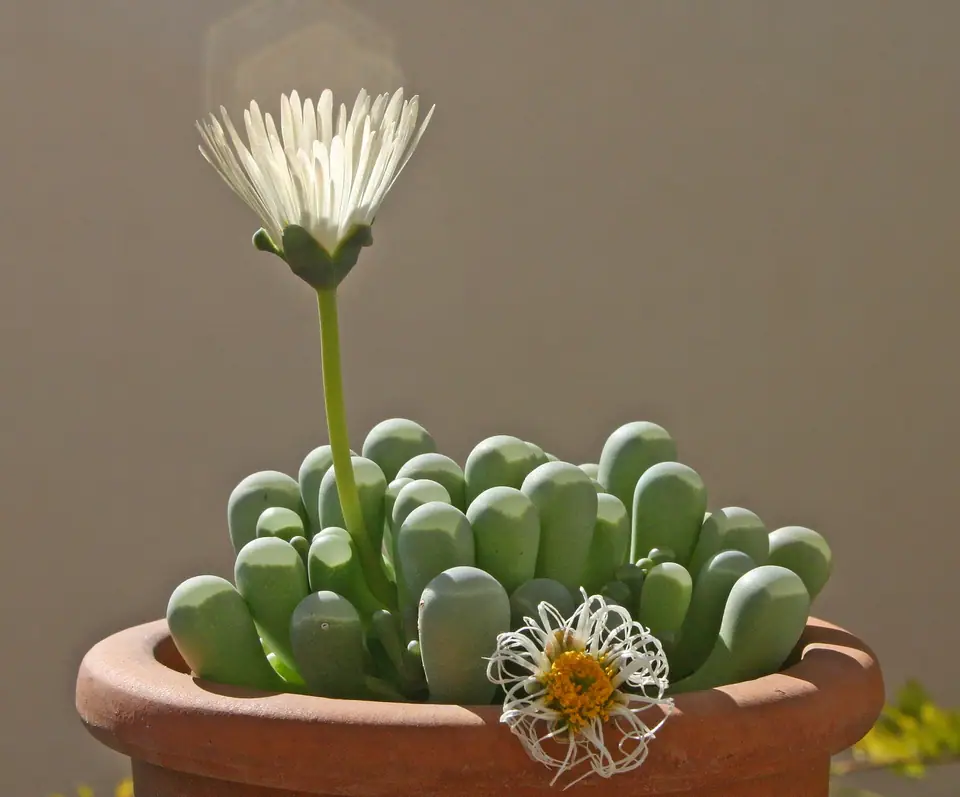
How to care for Baby Toes
Fenestraria rhopalophylla · Aizoaceae
Clusters of upright, club-shaped leaves tipped with translucent windows earn this Namibian succulent its nickname — the tips really do look like tiny toes. In habitat most of the leaf sits buried in sand with only the windows exposed to light. It rewards restraint with daisy-like white or yellow flowers, but it is deeply unforgiving of wet soil. Water roughly every 21 days while it's growing (about every 45 in winter), give it direct sun, kept above 45°F (7°C) — dry air is fine for it.
Care at a glance
Water sparingly and only when the leaves start to soften slightly; when in doubt, wait another week.
Give it the brightest, sunniest sill you own; weak light produces long, floppy, split-prone toes.
A single very dilute cactus feed per growing season, or none at all.
Mistakes that kill this plant
- Generous watering — split, mushy leaves are usually fatal to the cluster.
- Potting in standard houseplant soil instead of a gritty mineral mix.
- Deep shade, which turns the compact cluster into leaning, fragile stalks.
Seasonal tips
- It grows mainly in the cooler months — water a little more in autumn and spring.
- Keep it nearly dry through the heat of midsummer when it semi-dorms.
- Look for flowers from autumn into winter on happy plants.
Is it safe for pets?
We couldn’t place Baby Toes on a toxic or a non-toxic list, so its toxicity is unconfirmed — which is not the same as safe.
Full pet-safety details for cats & dogsCare for your Baby Toes on autopilot
Ploomily turns this guide into a Living Schedule — watering tuned to your city’s climate, the season, the pot and the light, and feeding tuned to that same pot, drainage and light, following the growing season and pausing while the plant rests. The founding price in force today is shown in full before you confirm, and locked for as long as you stay subscribed — with 30 days to change your mind.
Build my Living ScheduleMore succulent plants
Toxicity here is informational, not a safety guarantee. Those are our own records, compiled by following the ASPCA's published toxic and non-toxic plant lists and Pet Poison Helpline's plant poison list rather than copied from them — confirm anything that matters against those lists or with your vet. If your pet ingested this plant, contact your vet or the ASPCA Animal Poison Control Center at (888) 426-4435.