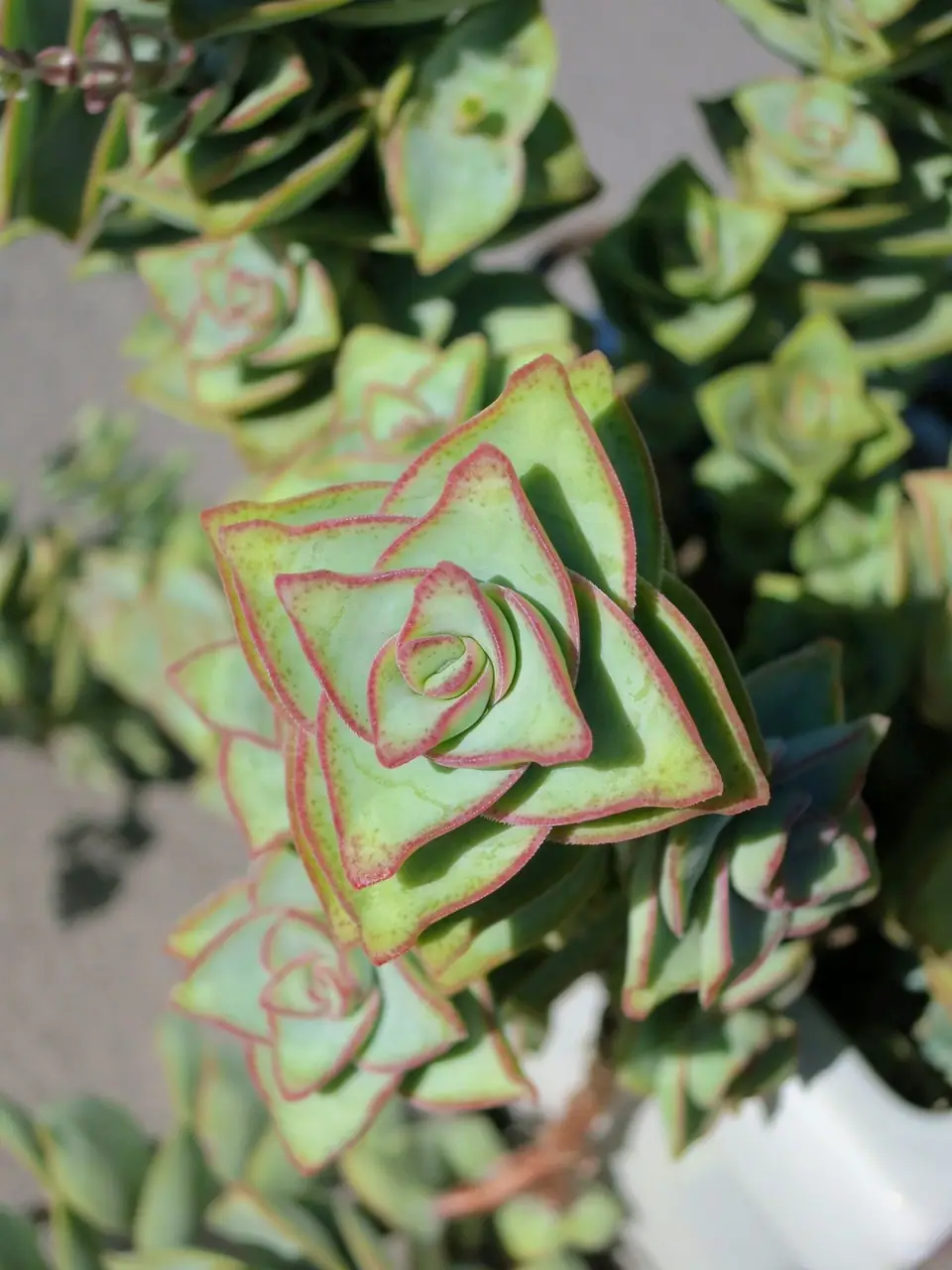
How to care for String of Buttons
Crassula perforata · Crassulaceae
A quirky stacking succulent whose triangular gray-green leaves appear threaded onto the stem like buttons on a string. Strong light brings out rosy pink edges along the leaf margins. Stems start upright and gracefully sprawl with age, making it lovely at the edge of a pot. Water roughly every 12 days while it's growing (about every 28 in winter), give it direct sun, kept above 45°F (7°C) — dry air is fine for it.
Care at a glance
Water deeply once the soil is fully dry; the stacked leaves wrinkle slightly when it genuinely needs a drink.
Several hours of direct sun keeps the stacks tight and the pink margins vivid; it stretches quickly in shade.
Diluted cactus fertilizer once or twice during the growing season.
Mistakes that kill this plant
- Growing it in a dim room, where it stretches into an unrecognizable sprawl.
- Frequent light waterings that keep the surface damp around the stem.
- Leaving water sitting between the stacked leaves in cool weather.
Seasonal tips
- Water even less in the heat of midsummer, when many crassulas semi-rest.
- Behead stretched stems in spring — tops re-root easily and the base rebranches.
- Bright cool winters intensify the pink leaf margins.
Is it safe for pets?
We have String of Buttons recorded as toxic to cats and dogs.
Full pet-safety details for cats & dogsCare for your String of Buttons on autopilot
Ploomily turns this guide into a Living Schedule — watering tuned to your city’s climate, the season, the pot and the light, and feeding tuned to that same pot, drainage and light, following the growing season and pausing while the plant rests. The founding price in force today is shown in full before you confirm, and locked for as long as you stay subscribed — with 30 days to change your mind.
Build my Living ScheduleString of Buttons is featured in
More succulent plants
Toxicity here is informational, not a safety guarantee. Those are our own records, compiled by following the ASPCA's published toxic and non-toxic plant lists and Pet Poison Helpline's plant poison list rather than copied from them — confirm anything that matters against Pet Poison Helpline's plant poison list, which this one is matched to, or with your vet. If your pet ingested this plant, contact your vet or the ASPCA Animal Poison Control Center at (888) 426-4435.