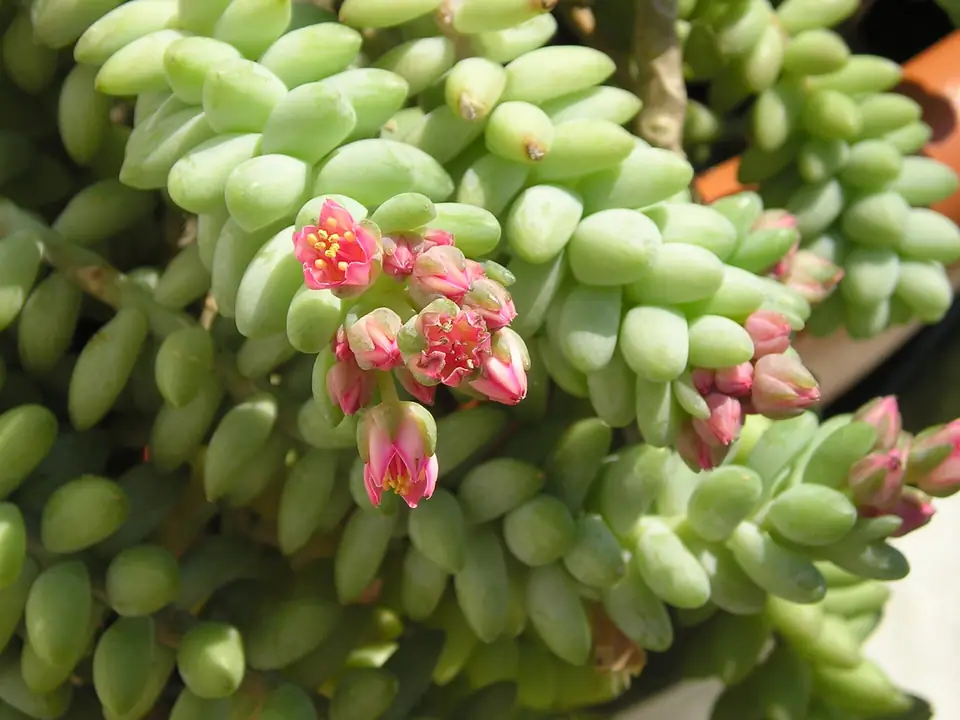
How to care for Burro's Tail
Sedum morganianum · Crassulaceae
A trailing sedum whose plump, overlapping blue-green leaves form thick braided tails up to a meter long. It is famously touchy — leaves detach at the slightest bump — so it belongs somewhere it will never be brushed against. Every fallen leaf, though, will happily root into a new plant. Water roughly every 14 days while it's growing (about every 30 in winter), give it direct sun, kept above 45°F (7°C) — dry air is fine for it.
Care at a glance
Soak only when the soil is thoroughly dry; the plump leaves wrinkle and dull slightly when the plant actually needs water.
Bright light with several hours of gentle direct sun; a bright east or west window keeps the tails dense.
Diluted cactus fertilizer once or twice per growing season.
Mistakes that kill this plant
- Overwatering — the thick tails need long, complete dry-outs.
- Repotting or moving mature plants often; the handling strips them bare.
- Dim placement, which produces thin, gappy, fragile growth.
Seasonal tips
- Hang it high and out of traffic — every brush costs a handful of leaves.
- Water monthly at most in winter and keep it cool and bright.
- Scatter dropped leaves on dry soil; most will root into backup plants.
Is it safe for pets?
Our records list Burro's Tail as non-toxic to cats and dogs.
Full pet-safety details for cats & dogsCare for your Burro's Tail on autopilot
Ploomily turns this guide into a Living Schedule — watering tuned to your city’s climate, the season, the pot and the light, and feeding tuned to that same pot, drainage and light, following the growing season and pausing while the plant rests. The founding price in force today is shown in full before you confirm, and locked for as long as you stay subscribed — with 30 days to change your mind.
Build my Living ScheduleBurro's Tail is featured in
More succulent plants
Toxicity here is informational, not a safety guarantee. Those are our own records, compiled by following the ASPCA's published toxic and non-toxic plant lists and Pet Poison Helpline's plant poison list rather than copied from them — confirm anything that matters against the ASPCA's published lists, which this one is matched to, or with your vet. If your pet ingested this plant, contact your vet or the ASPCA Animal Poison Control Center at (888) 426-4435.