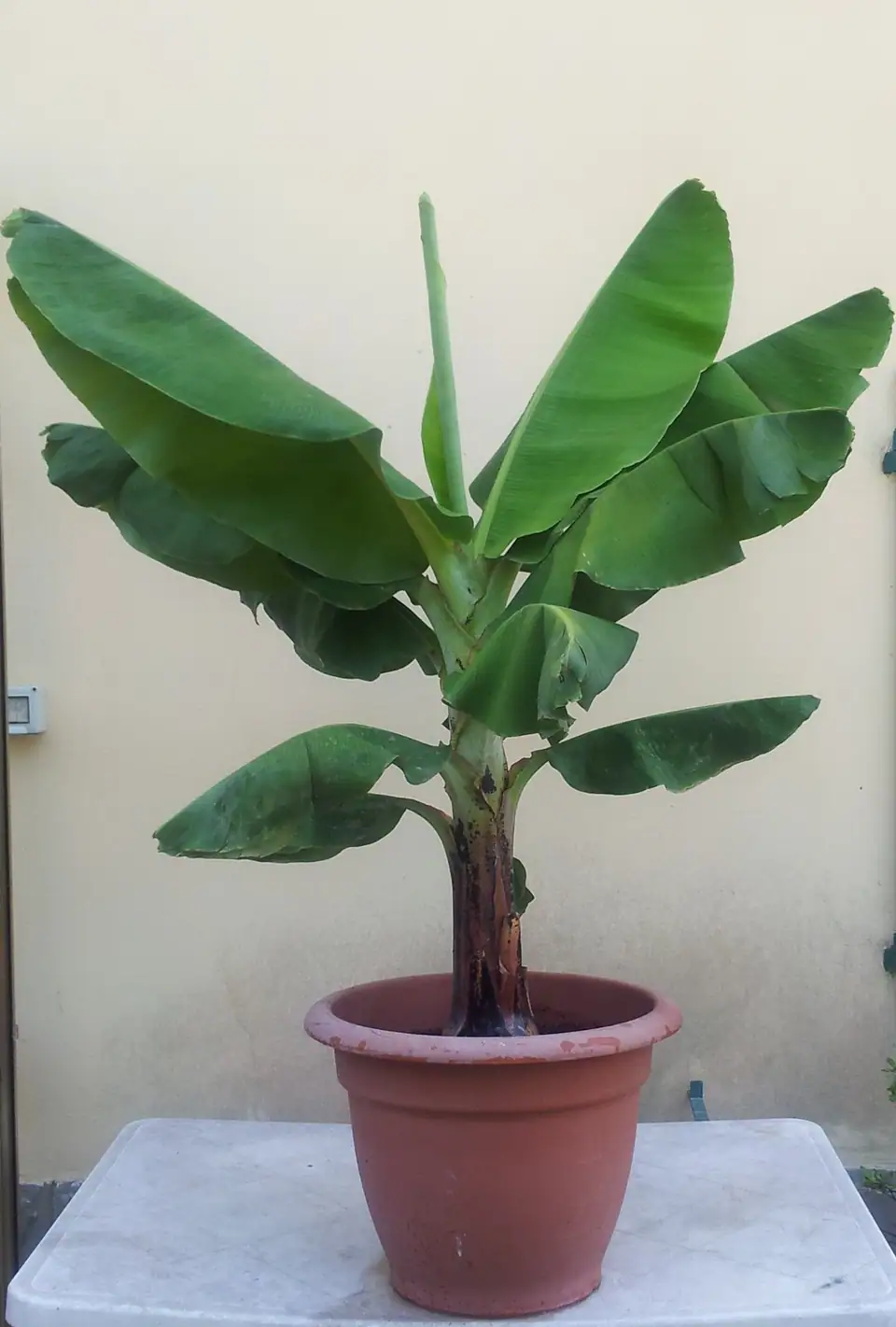
How to care for Dwarf Banana
Musa acuminata 'Dwarf Cavendish' · Musaceae
A fast, dramatic tropical with huge paddle leaves that unfurl weekly in good conditions, bringing instant jungle to a bright room. It is essentially a giant thirsty herb: give it maximum light, generous water, and regular food, and accept some tattered leaf edges as part of the look. Water roughly every 4 days while it's growing (about every 9 in winter), give it direct sun, kept above 55°F (13°C) — it wants humid air.
Care at a glance
In active growth water generously whenever the top few centimeters dry — its enormous leaves transpire heavily — but cut back sharply in winter.
The sunniest spot you own; anything less than strong light produces small leaves and a leaning, stalled plant.
A hungry feeder — balanced liquid fertilizer every two weeks throughout the growing season.
Mistakes that kill this plant
- Keeping the soil summer-wet through a cold, dark winter and rotting the corm.
- Chronic low light producing a weak, stunted plant that never recovers.
- Ignoring spider mites until every leaf is speckled grey.
Seasonal tips
- Move it outdoors for summer if possible — heat, sun, and rain transform it.
- Slow watering and stop feeding entirely in winter while growth pauses.
- Remove tired outer leaves at the base; pups appearing beside the main stem can be separated or left for a clump.
Is it safe for pets?
Our records list Dwarf Banana as non-toxic to cats and dogs.
Full pet-safety details for cats & dogsCare for your Dwarf Banana on autopilot
Ploomily turns this guide into a Living Schedule — watering tuned to your city’s climate, the season, the pot and the light, and feeding tuned to that same pot, drainage and light, following the growing season and pausing while the plant rests. The founding price in force today is shown in full before you confirm, and locked for as long as you stay subscribed — with 30 days to change your mind.
Build my Living ScheduleDwarf Banana is featured in
More tree plants
Toxicity here is informational, not a safety guarantee. Those are our own records, compiled by following the ASPCA's published toxic and non-toxic plant lists and Pet Poison Helpline's plant poison list rather than copied from them — confirm anything that matters against the ASPCA's published lists, which this one is matched to, or with your vet. If your pet ingested this plant, contact your vet or the ASPCA Animal Poison Control Center at (888) 426-4435.