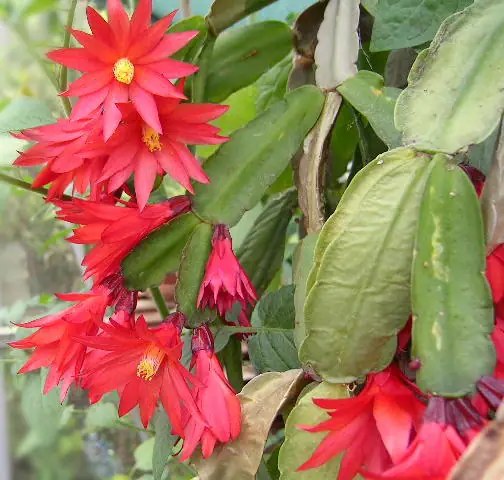
How to care for Easter Cactus
Schlumbergera gaertneri · Cactaceae
The spring-flowering holiday cactus, opening starburst-shaped scarlet-to-pink flowers around Easter rather than the tubular blooms of its winter cousins. Also known as Hatiora gaertneri, this Brazilian epiphyte is a touch fussier — it drops segments in protest at drafts, drought, or soggy soil. Steady conditions are the secret. Water roughly every 7 days while it's growing (about every 16 in winter), give it bright, indirect light, kept above 50°F (10°C) — average room humidity suits it.
Care at a glance
Keep moisture even — water when the top few centimeters dry, and avoid both hard drought and standing water.
Bright, filtered light without hot direct sun; an east-facing spot with stable temperatures is ideal.
Half-strength balanced fertilizer monthly after flowering ends through late summer.
Mistakes that kill this plant
- Erratic watering — this species punishes both extremes with mass segment drop.
- A warm winter that skips the cool rest, followed by decline instead of bloom.
- Repotting or relocating it at bud time, then overcorrecting with water as it protests.
Seasonal tips
- Cool winter nights (around 7-13 C) for 8-12 weeks set the spring flower buds.
- After bloom, resume feeding and slightly increase water for the summer growth push.
- Keep it away from radiators, drafts, and frequent relocation.
Is it safe for pets?
We couldn’t place Easter Cactus on a toxic or a non-toxic list, so its toxicity is unconfirmed — which is not the same as safe.
Full pet-safety details for cats & dogsCare for your Easter Cactus on autopilot
Ploomily turns this guide into a Living Schedule — watering tuned to your city’s climate, the season, the pot and the light, and feeding tuned to that same pot, drainage and light, following the growing season and pausing while the plant rests. The founding price in force today is shown in full before you confirm, and locked for as long as you stay subscribed — with 30 days to change your mind.
Build my Living ScheduleMore cactus plants
Toxicity here is informational, not a safety guarantee. Those are our own records, compiled by following the ASPCA's published toxic and non-toxic plant lists and Pet Poison Helpline's plant poison list rather than copied from them — confirm anything that matters against those lists or with your vet. If your pet ingested this plant, contact your vet or the ASPCA Animal Poison Control Center at (888) 426-4435.