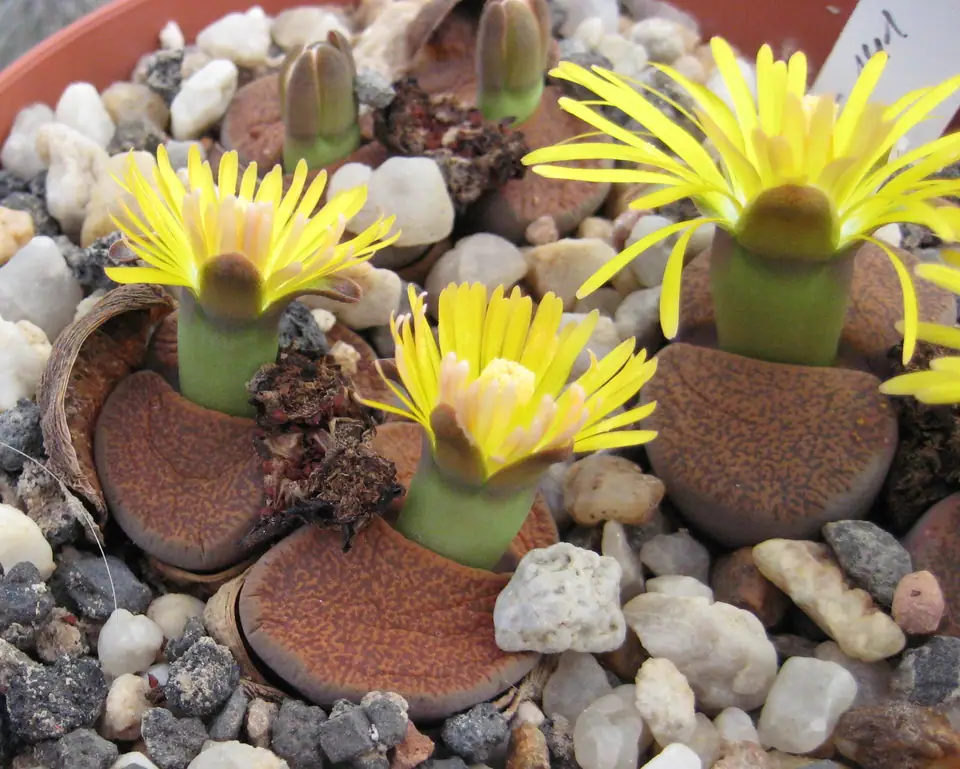
How to care for Living Stones
Lithops lesliei · Aizoaceae
These South African mimicry plants are little more than a pair of fused, pebble-like leaves that photosynthesize through translucent windows on top. They live on a strict annual rhythm — flowering in autumn, then consuming their old leaf pair over winter as a new pair forms inside. Mastering when NOT to water them is the entire art. Water roughly every 21 days while it's growing (about every 45 in winter), give it direct sun, kept above 45°F (7°C) — dry air is fine for it.
Care at a glance
Water modestly in spring and autumn only when fully dry, and stop completely while the old leaves are shriveling to feed the new pair.
They need 4-5 hours of direct sun on a south windowsill; anything less makes them stretch tall and split their skins.
Barely feed — a very dilute low-nitrogen cactus fertilizer once a year at most.
Mistakes that kill this plant
- Watering on a schedule instead of following the leaf-change cycle.
- Any watering while the old leaves are being absorbed.
- Rich organic potting soil, which holds water these plants cannot handle.
Seasonal tips
- Water in spring and again from late summer through autumn flowering.
- Keep completely dry from roughly late autumn until the old leaf pair is a papery husk.
- Grow in a deep pot of almost pure mineral grit — their taproot is longer than the plant.
Is it safe for pets?
We couldn’t place Living Stones on a toxic or a non-toxic list, so its toxicity is unconfirmed — which is not the same as safe.
Full pet-safety details for cats & dogsCare for your Living Stones on autopilot
Ploomily turns this guide into a Living Schedule — watering tuned to your city’s climate, the season, the pot and the light, and feeding tuned to that same pot, drainage and light, following the growing season and pausing while the plant rests. The founding price in force today is shown in full before you confirm, and locked for as long as you stay subscribed — with 30 days to change your mind.
Build my Living ScheduleMore succulent plants
Toxicity here is informational, not a safety guarantee. Those are our own records, compiled by following the ASPCA's published toxic and non-toxic plant lists and Pet Poison Helpline's plant poison list rather than copied from them — confirm anything that matters against those lists or with your vet. If your pet ingested this plant, contact your vet or the ASPCA Animal Poison Control Center at (888) 426-4435.