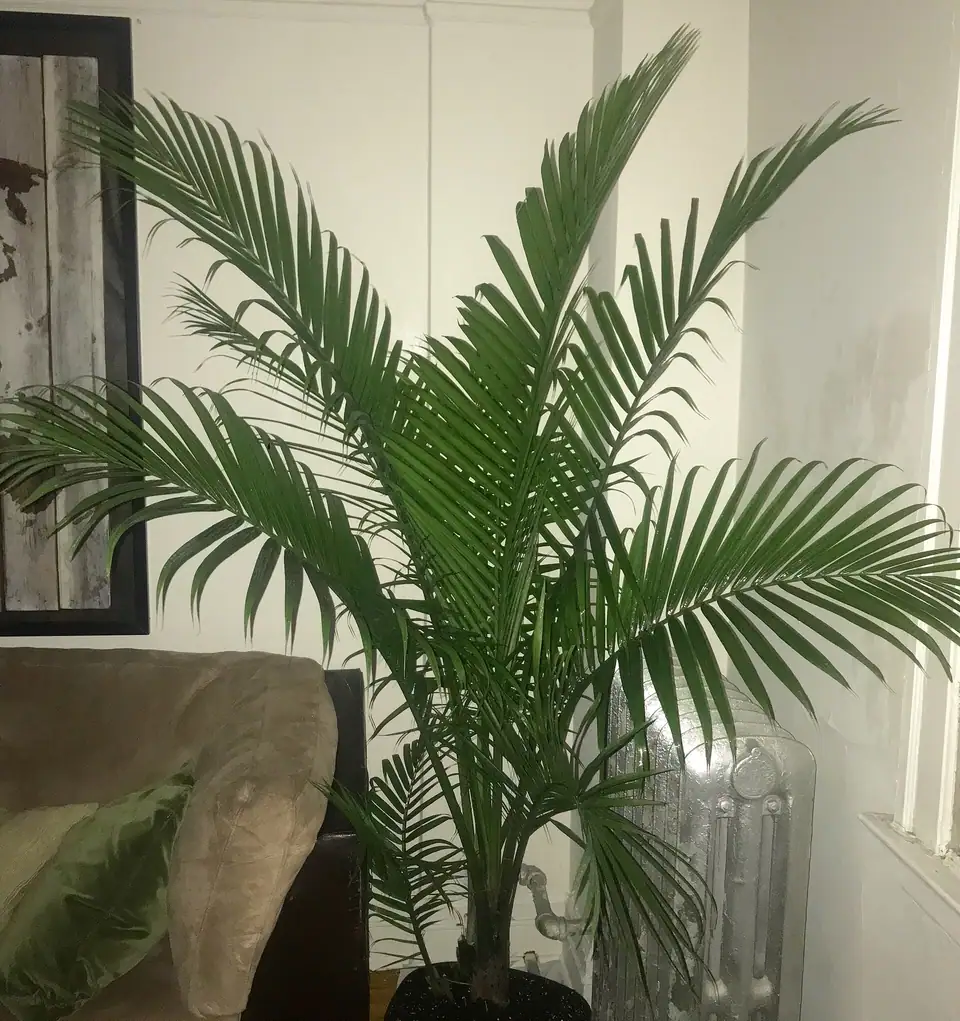
How to care for Majesty Palm
Ravenea rivularis · Arecaceae
A riverbank palm from Madagascar with long, gracefully arching dark-green fronds, sold cheaply everywhere but genuinely hard to keep happy indoors. In nature it grows with its feet near running water and its head in the sun — a combination most living rooms can't fake. It can thrive inside, but only with real light, real humidity, and unfailing moisture. Water roughly every 4 days while it's growing (about every 8 in winter), give it bright, indirect light, kept above 55°F (13°C) — it wants humid air.
Care at a glance
Keep the soil consistently moist (never swampy, never dry) — as a riverside species it resents drying out more than almost any houseplant.
Needs very bright light with some gentle direct sun — a large south or west window; ordinary room light is not enough.
Half-strength balanced feed monthly in the growing season, including magnesium if older fronds yellow.
Mistakes that kill this plant
- Buying it for a dim corner — it starves in typical indoor light.
- Letting the root ball dry out between waterings.
- Ignoring spider mites in dry winter air until the crown is grey.
Seasonal tips
- Summer outdoors in bright shade with generous water is its favorite vacation.
- Run a humidifier nearby in winter; heated air is its slow killer.
- Check weekly for spider mites under the leaflets — early showers stop outbreaks.
Is it safe for pets?
Our records list Majesty Palm as non-toxic to cats and dogs.
Full pet-safety details for cats & dogsCare for your Majesty Palm on autopilot
Ploomily turns this guide into a Living Schedule — watering tuned to your city’s climate, the season, the pot and the light, and feeding tuned to that same pot, drainage and light, following the growing season and pausing while the plant rests. The founding price in force today is shown in full before you confirm, and locked for as long as you stay subscribed — with 30 days to change your mind.
Build my Living ScheduleMajesty Palm is featured in
More palm plants
Toxicity here is informational, not a safety guarantee. Those are our own records, compiled by following the ASPCA's published toxic and non-toxic plant lists and Pet Poison Helpline's plant poison list rather than copied from them — confirm anything that matters against the ASPCA's published lists, which this one is matched to, or with your vet. If your pet ingested this plant, contact your vet or the ASPCA Animal Poison Control Center at (888) 426-4435.