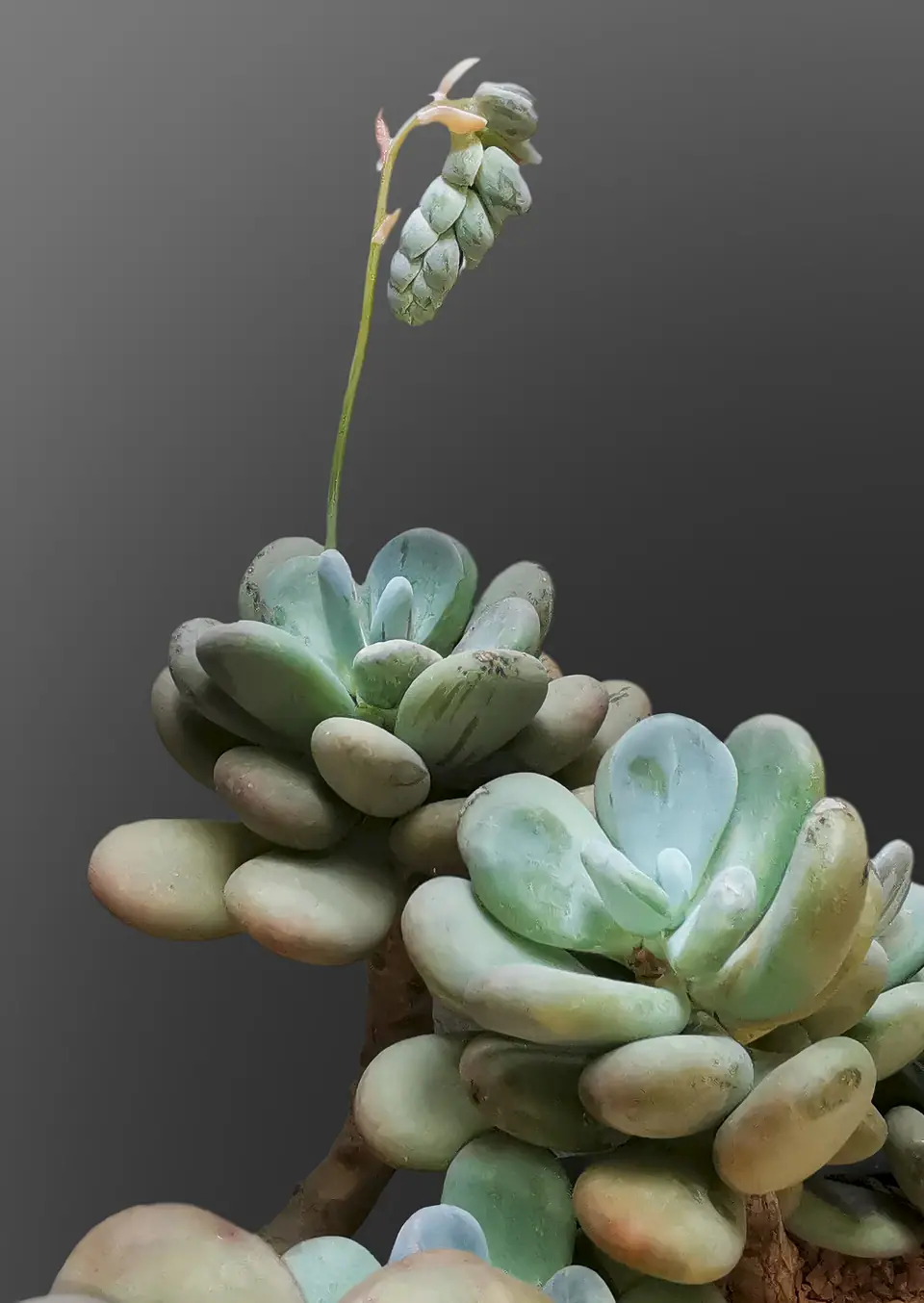
How to care for Moonstones
Pachyphytum oviferum · Crassulaceae
Plump, egg-shaped leaves in pastel blue, lilac, and pink cluster like a handful of sugared almonds — few succulents look this ornamental. A Mexican cliff-dweller, it wears a delicate powdery bloom that marks permanently at a touch. It asks for little beyond strong light, gritty soil, and disciplined watering. Water roughly every 16 days while it's growing (about every 35 in winter), give it direct sun, kept above 45°F (7°C) — dry air is fine for it.
Care at a glance
Water deeply only when the soil has been dry for days and the lowest leaves lose a little firmness.
Several hours of direct sun keep the leaves fat and pink-toned; it will stretch surprisingly fast in mere bright shade.
Quarter-strength cactus fertilizer once or twice in the growing season is ample.
Mistakes that kill this plant
- Frequent shallow watering that keeps the surface damp.
- Growing it a meter or more from the window until it collapses into a stretched vine.
- Water droplets sitting among the leaves in cool weather, inviting rot.
Seasonal tips
- Cool, bright, dry winters bring out the strongest lilac-pink coloring.
- Propagate spare leaves in spring — they root as easily as echeveria leaves.
- Handle only by the stem or rootball to preserve the powdery coating.
Is it safe for pets?
We couldn’t place Moonstones on a toxic or a non-toxic list, so its toxicity is unconfirmed — which is not the same as safe.
Full pet-safety details for cats & dogsCare for your Moonstones on autopilot
Ploomily turns this guide into a Living Schedule — watering tuned to your city’s climate, the season, the pot and the light, and feeding tuned to that same pot, drainage and light, following the growing season and pausing while the plant rests. The founding price in force today is shown in full before you confirm, and locked for as long as you stay subscribed — with 30 days to change your mind.
Build my Living ScheduleMore succulent plants
Toxicity here is informational, not a safety guarantee. Those are our own records, compiled by following the ASPCA's published toxic and non-toxic plant lists and Pet Poison Helpline's plant poison list rather than copied from them — confirm anything that matters against those lists or with your vet. If your pet ingested this plant, contact your vet or the ASPCA Animal Poison Control Center at (888) 426-4435.