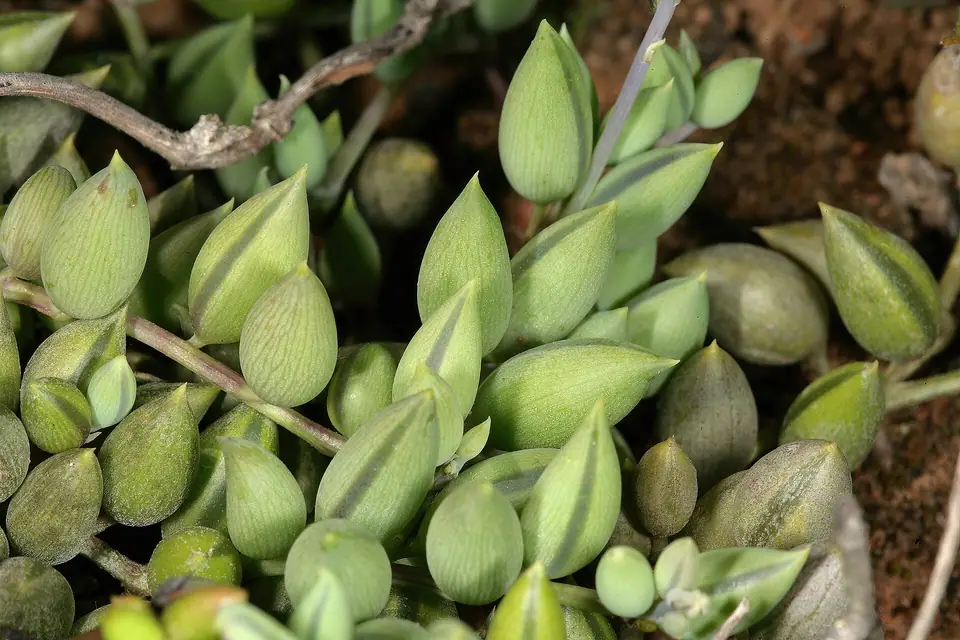
How to care for String of Bananas
Curio radicans · Asteraceae
The forgiving cousin of string of pearls, with glossy banana-shaped leaves on fast-growing trailing stems, formerly Senecio radicans. It tolerates watering mistakes far better and grows quickly enough to recover from setbacks. A great confidence-builder before attempting the fussier trailing succulents. Water roughly every 12 days while it's growing (about every 25 in winter), give it bright, indirect light, kept above 50°F (10°C) — dry air is fine for it.
Care at a glance
Water deeply when the soil is fully dry; the little bananas flatten and dull slightly when the plant wants water.
Bright light with a few hours of gentle sun; it handles a bit more shade than string of pearls without collapsing.
Quarter-strength balanced fertilizer every 4-6 weeks during active growth.
Mistakes that kill this plant
- Treating its easygoing reputation as license to overwater.
- Deep, moisture-retentive pots that keep the shallow roots wet.
- Dark placement, which slowly thins the strands to threads.
Seasonal tips
- Trim and re-plant cuttings into the top of the pot to keep the crown full.
- Reduce watering by half in winter and keep it in your brightest window.
- It grows fast in spring — feed lightly and let it trail or climb along a support.
Is it safe for pets?
We have String of Bananas recorded as toxic to cats and dogs.
Full pet-safety details for cats & dogsCare for your String of Bananas on autopilot
Ploomily turns this guide into a Living Schedule — watering tuned to your city’s climate, the season, the pot and the light, and feeding tuned to that same pot, drainage and light, following the growing season and pausing while the plant rests. The founding price in force today is shown in full before you confirm, and locked for as long as you stay subscribed — with 30 days to change your mind.
Build my Living ScheduleString of Bananas is featured in
More succulent plants
Toxicity here is informational, not a safety guarantee. Those are our own records, compiled by following the ASPCA's published toxic and non-toxic plant lists and Pet Poison Helpline's plant poison list rather than copied from them — confirm anything that matters against the ASPCA's published lists, which this one is matched to, or with your vet. If your pet ingested this plant, contact your vet or the ASPCA Animal Poison Control Center at (888) 426-4435.