How to care for Tiger Jaws
Faucaria tigrina · Aizoaceae
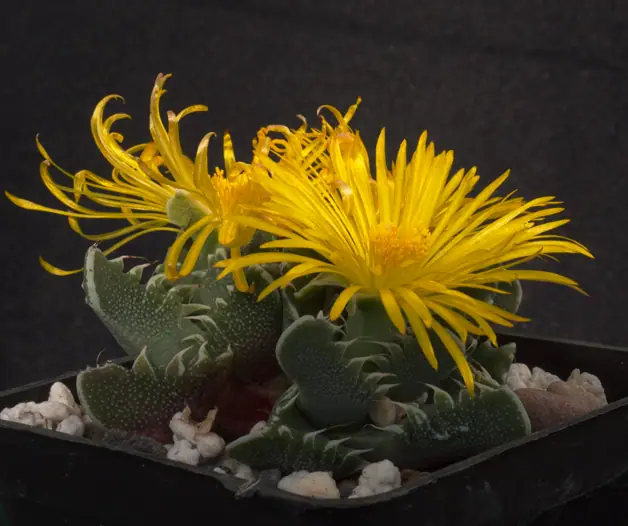
Pairs of thick triangular leaves lined with soft, harmless teeth open like gaping jaws, giving this small South African succulent real character in a tiny pot. The 'fangs' are actually flexible hairs that help condense fog in habitat. In autumn, good light is rewarded with surprisingly large golden-yellow flowers. Water roughly every 16 days while it's growing (about every 35 in winter), give it direct sun, kept above 45°F (7°C) — dry air is fine for it.
Care at a glance
Water deeply once the soil has been dry for a few days, easing off sharply in winter.
A few hours of direct sun keeps the rosettes tight and triggers autumn flowering; a south or west sill is ideal.
Dilute cactus fertilizer once or twice during spring and summer.
Mistakes that kill this plant
- Winter watering at tropical-houseplant frequency.
- Dense, peaty soil around the fleshy base.
- Dim placement that slowly starves and stretches it over a season.
Seasonal tips
- Expect flowers in autumn — they open in afternoon sun and close at night.
- Keep it cool and quite dry in winter; it tolerates chilly bright rooms well.
- Repot rarely and shallowly in a gritty mix; it resents root disturbance.
Is it safe for pets?
We couldn’t place Tiger Jaws on a toxic or a non-toxic list, so its toxicity is unconfirmed — which is not the same as safe.
Full pet-safety details for cats & dogsCare for your Tiger Jaws on autopilot
Ploomily turns this guide into a Living Schedule — watering tuned to your city’s climate, the season, the pot and the light, and feeding tuned to that same pot, drainage and light, following the growing season and pausing while the plant rests. The founding price in force today is shown in full before you confirm, and locked for as long as you stay subscribed — with 30 days to change your mind.
Build my Living ScheduleMore succulent plants
Toxicity here is informational, not a safety guarantee. Those are our own records, compiled by following the ASPCA's published toxic and non-toxic plant lists and Pet Poison Helpline's plant poison list rather than copied from them — confirm anything that matters against those lists or with your vet. If your pet ingested this plant, contact your vet or the ASPCA Animal Poison Control Center at (888) 426-4435.