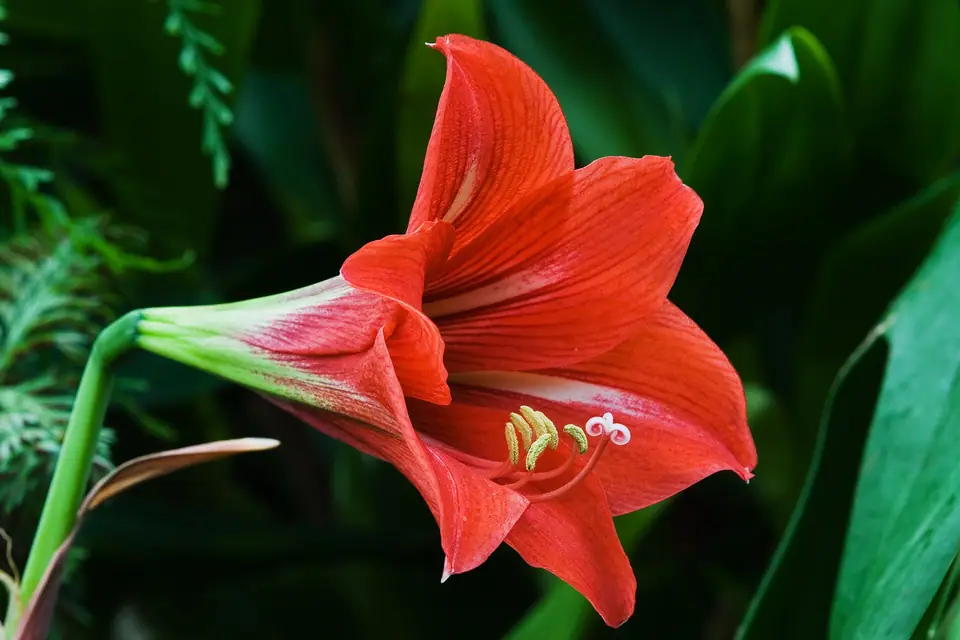
How to care for Amaryllis
Hippeastrum × hybridum · Amaryllidaceae
Amaryllis grows from a large bulb into towering stalks topped with enormous trumpet blooms, a winter showpiece that is nearly foolproof to flower the first time. The real craft is the after-show: feeding the strappy leaves all summer and giving the bulb an autumn rest so it blooms again next year. Handled that way, one bulb performs for decades. Water roughly every 6 days while it's growing (about every 30 in autumn), give it bright, indirect light, kept above 55°F (13°C) — dry air is fine for it.
Care at a glance
Water when the top few centimeters dry while in leaf or bloom, keeping water off the bulb's nose; stop almost entirely during the autumn rest.
Very bright light — even direct sun — during leaf growth; rotate the pot so the flower stalk grows straight.
Balanced liquid feed at half strength every 2 weeks after flowering, while the leaves recharge the bulb.
Mistakes that kill this plant
- Letting pets chew the plant or dig the bulb — it is genuinely toxic.
- Burying the bulb completely and keeping it wet, which rots it.
- Cutting the leaves off after bloom, starving the bulb of next year's flower.
Seasonal tips
- Plant with the top third of the bulb above the soil line, in a pot only a few centimeters wider than the bulb.
- After blooming, cut the stalk but keep the leaves growing in strong light all summer — they fuel next year's flowers.
- In early autumn, withhold water for 8–10 weeks of cool rest, then restart with fresh topsoil and a good drink.
Is it safe for pets?
We have Amaryllis recorded as toxic to cats and dogs.
Full pet-safety details for cats & dogsCare for your Amaryllis on autopilot
Ploomily turns this guide into a Living Schedule — watering tuned to your city’s climate, the season, the pot and the light, and feeding tuned to that same pot, drainage and light, following the growing season and pausing while the plant rests. The founding price in force today is shown in full before you confirm, and locked for as long as you stay subscribed — with 30 days to change your mind.
Build my Living ScheduleAmaryllis is featured in
More flowering plants
Toxicity here is informational, not a safety guarantee. Those are our own records, compiled by following the ASPCA's published toxic and non-toxic plant lists and Pet Poison Helpline's plant poison list rather than copied from them — confirm anything that matters against the ASPCA's published lists, which this one is matched to, or with your vet. If your pet ingested this plant, contact your vet or the ASPCA Animal Poison Control Center at (888) 426-4435.