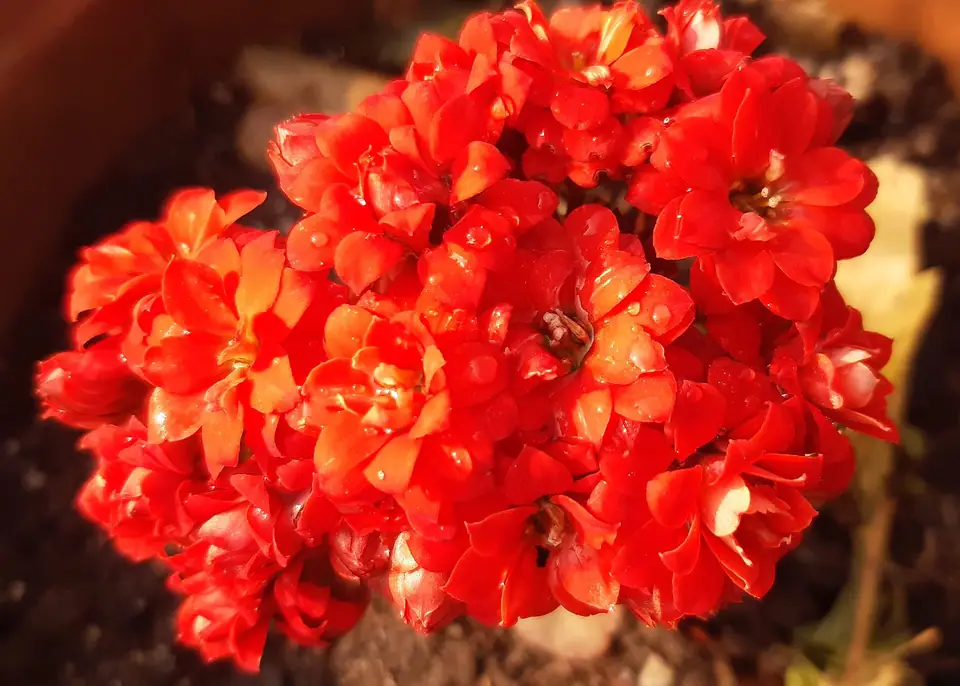
How to care for Flaming Katy
Kalanchoe blossfeldiana · Crassulaceae
The florist kalanchoe, sold everywhere in bud, packs clusters of long-lasting scarlet, orange, pink, or yellow flowers above glossy scalloped leaves. It is a true succulent underneath the blooms, so it wants succulent treatment, not weekly houseplant watering. With a short-day rest in autumn it will rebloom year after year. Water roughly every 10 days while it's growing (about every 21 in winter), give it bright, indirect light, kept above 50°F (10°C) — dry air is fine for it.
Care at a glance
Water thoroughly when the top few centimeters are dry; while in heavy bloom it drinks a bit faster than a typical succulent.
Bright light with some gentle morning sun keeps it compact and blooming; hot afternoon sun can scorch the glossy leaves.
Half-strength balanced fertilizer monthly while growing; pause while it is in full flower.
Mistakes that kill this plant
- Treating it like a thirsty annual — soggy soil rots it within a month.
- Leaving it where cats or dogs can chew the leaves or flowers.
- Tossing it after bloom instead of resting it; it reblooms reliably with a dark autumn treatment.
Seasonal tips
- Deadhead spent flower clusters and cut stems back lightly to encourage bushiness.
- For rebloom, give it 6 weeks of long nights (about 14 hours of darkness) in autumn.
- Keep it cool and on the dry side in winter to set buds.
Is it safe for pets?
We have Flaming Katy recorded as toxic to cats and dogs.
Full pet-safety details for cats & dogsCare for your Flaming Katy on autopilot
Ploomily turns this guide into a Living Schedule — watering tuned to your city’s climate, the season, the pot and the light, and feeding tuned to that same pot, drainage and light, following the growing season and pausing while the plant rests. The founding price in force today is shown in full before you confirm, and locked for as long as you stay subscribed — with 30 days to change your mind.
Build my Living ScheduleFlaming Katy is featured in
More flowering plants
Toxicity here is informational, not a safety guarantee. Those are our own records, compiled by following the ASPCA's published toxic and non-toxic plant lists and Pet Poison Helpline's plant poison list rather than copied from them — confirm anything that matters against the ASPCA's published lists, which this one is matched to, or with your vet. If your pet ingested this plant, contact your vet or the ASPCA Animal Poison Control Center at (888) 426-4435.