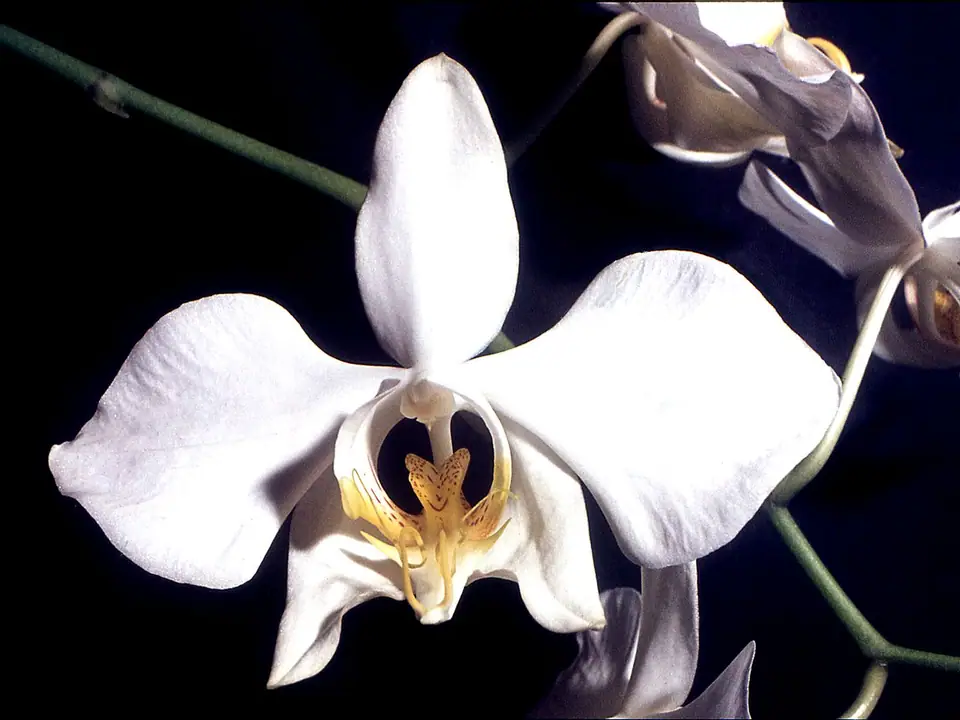
How to care for Moth Orchid
Phalaenopsis amabilis · Orchidaceae
The moth orchid is the world's most popular houseplant orchid for good reason: its arching sprays of blooms last for months, and it thrives at ordinary room temperatures. It grows in bark rather than soil, with thick silvery roots that photosynthesize. Once you unlearn soil-plant habits, it is genuinely easy. Water roughly every 7 days while it's growing (about every 10 in winter), give it bright, indirect light, kept above 61°F (16°C) — average room humidity suits it.
Care at a glance
Water when the roots turn silvery and the bark is dry — soak the pot thoroughly, drain completely, and never leave water in the crown or cachepot.
An east window is classic; leaves should be olive green — very dark green means too little light, red-tinged means too much.
Quarter-strength orchid fertilizer every other watering — 'weakly, weekly' beats occasional strong doses.
Mistakes that kill this plant
- Leaving it standing in water inside a decorative pot with no drainage.
- Watering into the crown and letting water sit there, causing crown rot.
- Never repotting, so the bark decomposes into a root-smothering mush.
Seasonal tips
- A few weeks of cooler autumn nights (around 61–64°F (16–18°C)) triggers a new bloom spike.
- After flowering, cut the spent spike above a node for a possible rebloom, or at the base to let the plant rest.
- Repot into fresh bark every couple of years — old, broken-down bark suffocates roots even with perfect watering.
Is it safe for pets?
Our records list Moth Orchid as non-toxic to cats and dogs.
Full pet-safety details for cats & dogsCare for your Moth Orchid on autopilot
Ploomily turns this guide into a Living Schedule — watering tuned to your city’s climate, the season, the pot and the light, and feeding tuned to that same pot, drainage and light, following the growing season and pausing while the plant rests. The founding price in force today is shown in full before you confirm, and locked for as long as you stay subscribed — with 30 days to change your mind.
Build my Living ScheduleMoth Orchid is featured in
More flowering plants
Toxicity here is informational, not a safety guarantee. Those are our own records, compiled by following the ASPCA's published toxic and non-toxic plant lists and Pet Poison Helpline's plant poison list rather than copied from them — confirm anything that matters against the ASPCA's published lists, which this one is matched to, or with your vet. If your pet ingested this plant, contact your vet or the ASPCA Animal Poison Control Center at (888) 426-4435.