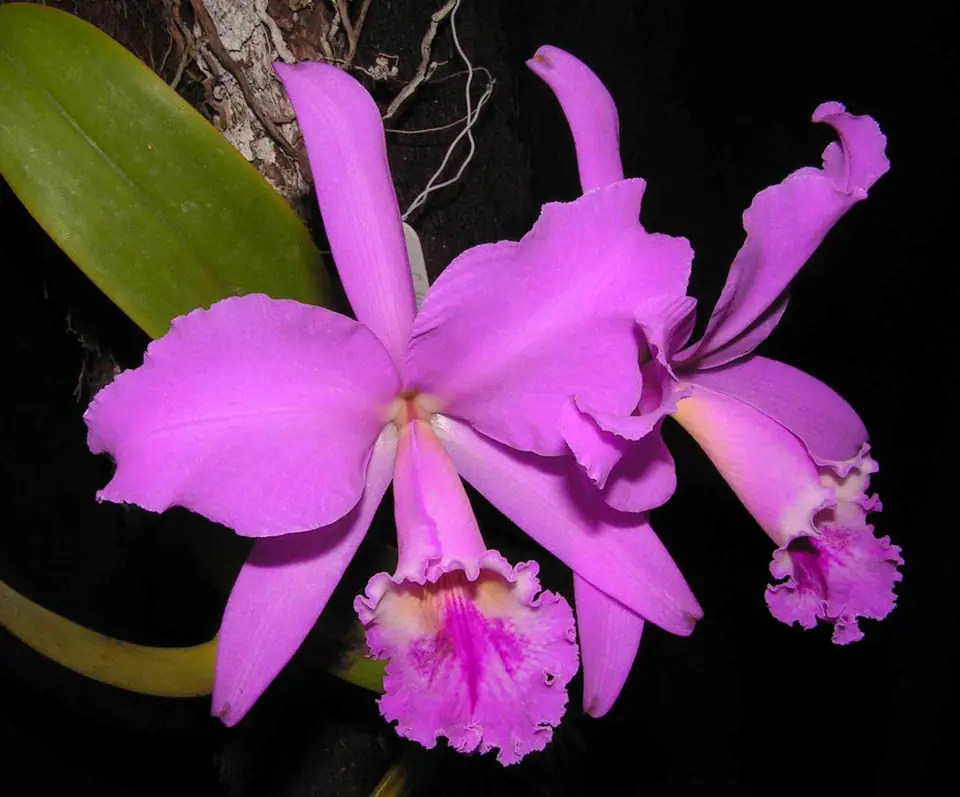
How to care for Cattleya Orchid
Cattleya labiata · Orchidaceae
The classic corsage orchid, Cattleya bears large, often gloriously fragrant blooms with a flamboyant ruffled lip. It stores water in thick pseudobulbs and demands stronger light than most windowsill orchids. Give it brightness, a fast-drying mix, and a wet-dry cycle, and it flowers reliably every year. Water roughly every 7 days while it's growing (about every 12 in winter), give it bright, indirect light, kept above 55°F (13°C) — average room humidity suits it.
Care at a glance
Drench thoroughly, then let the coarse bark mix dry out almost completely before watering again — the pseudobulbs carry it between drinks.
The brightest spot you have short of scorching midday sun — a lightly shaded south or west window; leaves should be light yellow-green.
Half-strength balanced orchid fertilizer every 2 weeks in active growth, flushing with plain water monthly.
Mistakes that kill this plant
- Growing it in moth-orchid light levels and wondering why it never blooms.
- Keeping the mix constantly moist with no dry-down.
- Repotting at the wrong time and snapping the new lead's roots.
Seasonal tips
- Repot only when new roots are just emerging, right after flowering — cattleyas resent disturbance at other times.
- A 41–46°F (5–8°C) day-night temperature drop helps initiate flower buds.
- In summer, more light plus more water; in winter, bright but noticeably drier.
Is it safe for pets?
Our records list Cattleya Orchid as non-toxic to cats and dogs.
Full pet-safety details for cats & dogsCare for your Cattleya Orchid on autopilot
Ploomily turns this guide into a Living Schedule — watering tuned to your city’s climate, the season, the pot and the light, and feeding tuned to that same pot, drainage and light, following the growing season and pausing while the plant rests. The founding price in force today is shown in full before you confirm, and locked for as long as you stay subscribed — with 30 days to change your mind.
Build my Living ScheduleCattleya Orchid is featured in
More flowering plants
Toxicity here is informational, not a safety guarantee. Those are our own records, compiled by following the ASPCA's published toxic and non-toxic plant lists and Pet Poison Helpline's plant poison list rather than copied from them — confirm anything that matters against the ASPCA's published lists, which this one is matched to, or with your vet. If your pet ingested this plant, contact your vet or the ASPCA Animal Poison Control Center at (888) 426-4435.