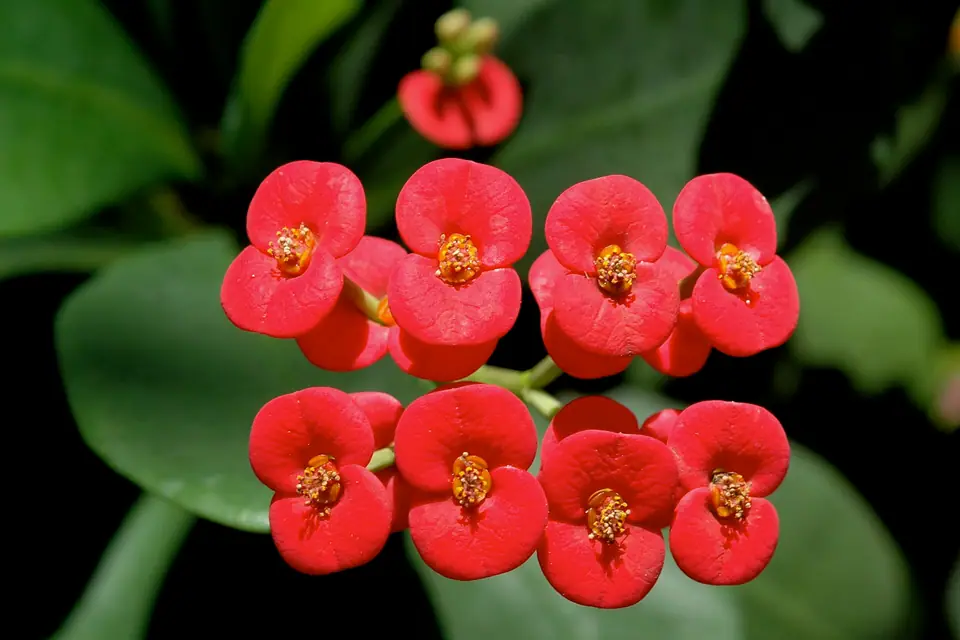
How to care for Crown of Thorns
Euphorbia milii · Euphorbiaceae
A Madagascan shrub armored in stout spines but crowned nearly year-round with cheerful red, pink, or yellow bracts on sunny sills. It is one of the few succulents that flowers reliably indoors, asking only for real sun and a light hand with water. The thorns and irritant sap mean it earns its biblical name — place it thoughtfully. Water roughly every 10 days while it's growing (about every 24 in winter), give it direct sun, kept above 55°F (13°C) — dry air is fine for it.
Care at a glance
Water when the top few centimeters dry out; unlike stricter succulents it dislikes bone-dry extremes while blooming.
At least 3-4 hours of direct sun daily is the price of continuous flowering; a south window is best.
Half-strength balanced fertilizer monthly from spring through autumn sustains steady blooming.
Mistakes that kill this plant
- Cold, wet winter conditions combined — the classic decline.
- Swinging between soaked and desert-dry, which strips leaves and buds.
- Placing this spiny, toxic-sapped plant where kids or pets brush past it.
Seasonal tips
- Deadhead faded bract clusters to keep new flushes coming.
- Expect partial leaf drop in winter — normal, not a crisis; water less until spring.
- Prune lightly in early spring (gloves on) to keep the shrub compact.
Is it safe for pets?
We have Crown of Thorns recorded as toxic to cats and dogs.
Full pet-safety details for cats & dogsCare for your Crown of Thorns on autopilot
Ploomily turns this guide into a Living Schedule — watering tuned to your city’s climate, the season, the pot and the light, and feeding tuned to that same pot, drainage and light, following the growing season and pausing while the plant rests. The founding price in force today is shown in full before you confirm, and locked for as long as you stay subscribed — with 30 days to change your mind.
Build my Living ScheduleCrown of Thorns is featured in
More succulent plants
Toxicity here is informational, not a safety guarantee. Those are our own records, compiled by following the ASPCA's published toxic and non-toxic plant lists and Pet Poison Helpline's plant poison list rather than copied from them — confirm anything that matters against Pet Poison Helpline's plant poison list, which this one is matched to, or with your vet. If your pet ingested this plant, contact your vet or the ASPCA Animal Poison Control Center at (888) 426-4435.