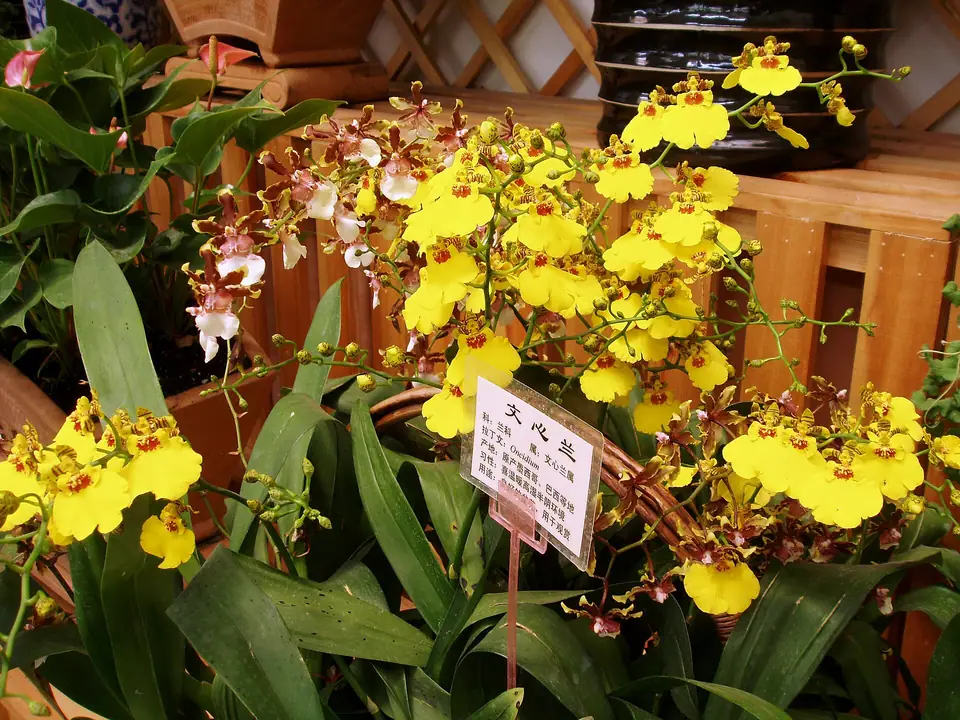
How to care for Dancing Lady Orchid
Oncidium flexuosum · Orchidaceae
Oncidiums send up tall, branching sprays crowded with small golden-yellow blooms that flutter like dancers' skirts in the slightest breeze. They grow quickly, forming clusters of flattened pseudobulbs. They like more frequent water than cattleyas while in growth, but the same excellent drainage. Water roughly every 5 days while it's growing (about every 10 in winter), give it bright, indirect light, kept above 54°F (12°C) — average room humidity suits it.
Care at a glance
Water when the top of the fine bark mix dries; keep moisture steady while new pseudobulbs are swelling, drier once they mature.
Bright, filtered light near an east or lightly shaded west window; strong enough that leaves stay yellowish-green, not deep green.
Quarter-to-half-strength balanced orchid feed every 2 weeks while in active growth.
Mistakes that kill this plant
- Letting the plant sit in soggy, decomposed bark.
- Chronic underwatering during growth, producing crippled accordion leaves.
- Deep shade, which stops blooming and weakens the pseudobulbs.
Seasonal tips
- Wrinkled pseudobulbs after flowering are normal; don't drown the plant trying to plump them.
- Cut the flower spike at the base once blooms fade — oncidium spikes don't rebloom.
- Repot after flowering when new growth starts, before the mix sours.
Is it safe for pets?
Our records list Dancing Lady Orchid as non-toxic to cats and dogs.
Full pet-safety details for cats & dogsCare for your Dancing Lady Orchid on autopilot
Ploomily turns this guide into a Living Schedule — watering tuned to your city’s climate, the season, the pot and the light, and feeding tuned to that same pot, drainage and light, following the growing season and pausing while the plant rests. The founding price in force today is shown in full before you confirm, and locked for as long as you stay subscribed — with 30 days to change your mind.
Build my Living ScheduleDancing Lady Orchid is featured in
More flowering plants
Toxicity here is informational, not a safety guarantee. Those are our own records, compiled by following the ASPCA's published toxic and non-toxic plant lists and Pet Poison Helpline's plant poison list rather than copied from them — confirm anything that matters against the ASPCA's published lists, which this one is matched to, or with your vet. If your pet ingested this plant, contact your vet or the ASPCA Animal Poison Control Center at (888) 426-4435.