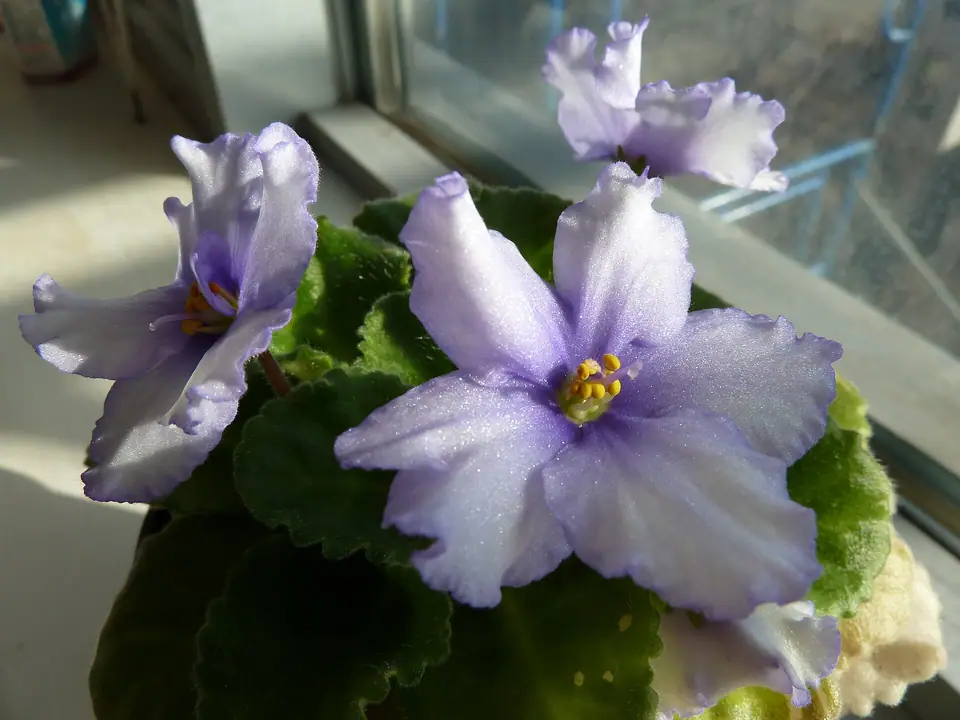
How to care for African Violet
Streptocarpus ionanthus · Gesneriaceae
The African violet is a compact rosette of velvety leaves that can bloom nearly year-round in shades of purple, pink, and white. It has devoted fans for good reason: give it steady warmth, bright shade, and careful watering, and it flowers indoors like almost nothing else. Its main quirks are a hatred of cold water on the leaves and of soggy soil. Water roughly every 5 days while it's growing (about every 8 in winter), give it bright, indirect light, kept above 61°F (16°C) — average room humidity suits it.
Care at a glance
Water with room-temperature water when the surface feels dry, from the bottom or under the leaves — cold water splashed on foliage leaves permanent spots.
A bright east or north window, or under grow lights; direct midday sun bleaches the velvet leaves.
Quarter-strength African violet fertilizer every 2 weeks — steady weak feeding sustains constant bloom.
Mistakes that kill this plant
- Cold water on the leaves or roots, causing spots and shock.
- Overpotting into a large container of dense, wet soil.
- Interpreting a rot-wilt as thirst and watering it to death.
Seasonal tips
- Keep it in a small pot — about one-third the leaf-span diameter — since a snug root ball encourages bloom.
- In winter, keep leaves from touching cold glass and shield the plant from drafts.
- Refresh the soil and bury the lengthening 'neck' at repotting time each year.
Is it safe for pets?
Our records list African Violet as non-toxic to cats and dogs.
Full pet-safety details for cats & dogsCare for your African Violet on autopilot
Ploomily turns this guide into a Living Schedule — watering tuned to your city’s climate, the season, the pot and the light, and feeding tuned to that same pot, drainage and light, following the growing season and pausing while the plant rests. The founding price in force today is shown in full before you confirm, and locked for as long as you stay subscribed — with 30 days to change your mind.
Build my Living ScheduleAfrican Violet is featured in
More flowering plants
Toxicity here is informational, not a safety guarantee. Those are our own records, compiled by following the ASPCA's published toxic and non-toxic plant lists and Pet Poison Helpline's plant poison list rather than copied from them — confirm anything that matters against the ASPCA's published lists, which this one is matched to, or with your vet. If your pet ingested this plant, contact your vet or the ASPCA Animal Poison Control Center at (888) 426-4435.